Share this article
If this helped you, share it with a fellow importer/exporter!
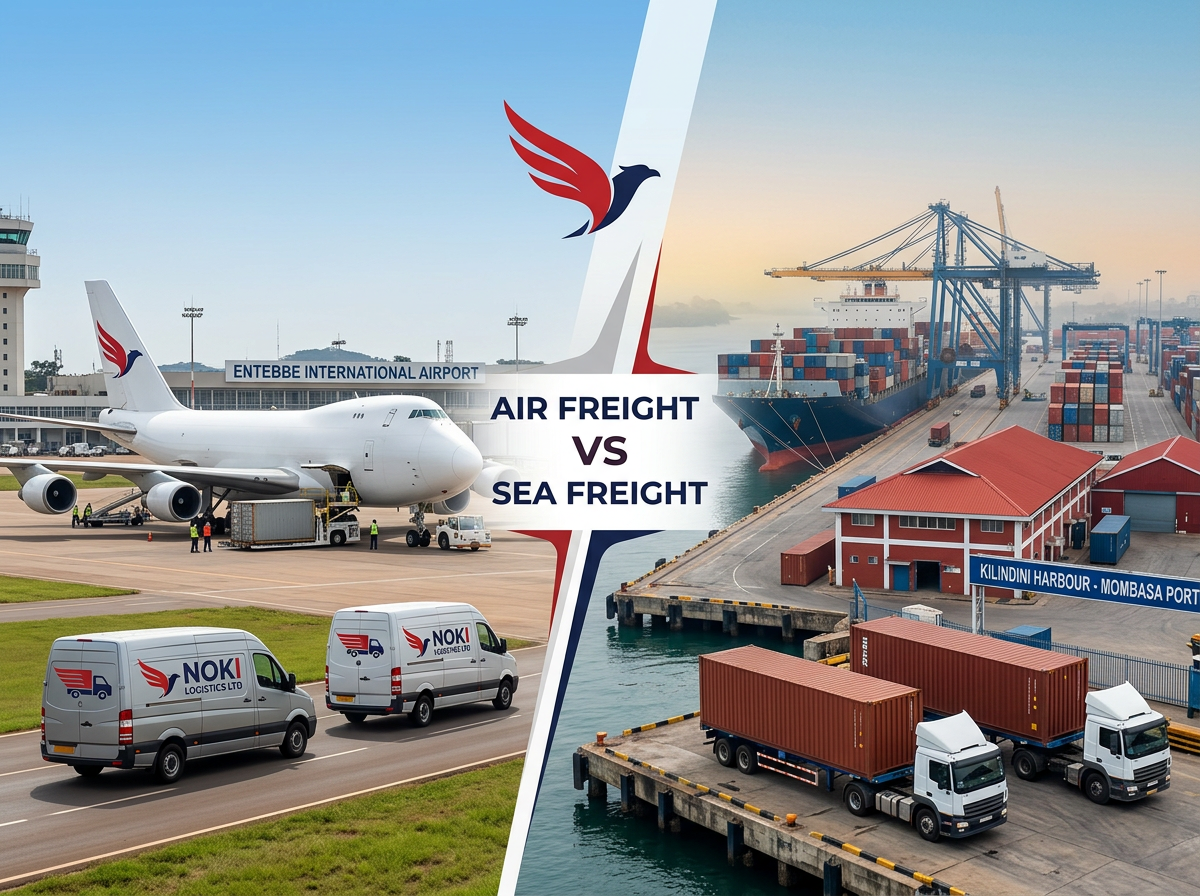
When shipping cargo into or out of Uganda, one of the most critical decisions business owners face is choosing between Air Freight and Sea Freight. The choice you make directly impacts your bottom line, your cash flow, and your customer satisfaction.
In 2026, global shipping dynamics have evolved. At Noki Logistics, we breakdown the exact financial and logistical differences to help you decide which mode of transport actually saves you more money right now.
Traditionally, Sea Freight (via ports like Mombasa or Dar es Salaam) is highly economical for heavy and bulky goods, but takes 30-45 days to reach Kampala. Air Freight (via Entebbe) guarantees delivery in under 5 days, but at a premium cost. However, the calculation involves more than just the base shipping rate.
If your cargo weighs over 500kg and has a large dimensional volume (like machinery, vehicles, or bulk agricultural inputs), Sea Freight is undeniably the winner in raw cost savings. Full Container Loads (FCL) provide the best economy of scale. If your supply chain is well-planned and you can endure the 4-week transit time, ocean shipping protects your profit margins significantly.
A common misconception is that Air Freight is always more expensive. If your shipment is under 200kg (like electronics, pharmaceuticals, or high-value spare parts), the cost difference between air and sea shrinks dramatically. Why? Because Sea Freight involves port handling charges, prolonged warehousing fees, and inland transportation costs from Mombasa to Kampala.
Most importantly, Air Freight saves you the hidden cost of time. If running out of inventory costs your business thousands of dollars a day, paying a premium for a 3-day flight is infinitely cheaper than waiting 40 days for a ship.
We frequently advise clients to use a hybrid approach: ship 80% of your bulky inventory via Sea Freight to maintain low unit costs, and fly in 20% of your critical, high-demand stock via Air Freight to keep cash flow moving instantly.
Which freight mode do you rely on the most for your business? Have you considered a hybrid model? Let us know in the comments below!